Action Research: Building a Cohesive Strategy
Introduction
This section brings together three key assignments that form the foundation of my Action Research project:
- Outline – frames the initial idea and scope
- Literature Review – provides the research base
- Action Research Plan – turns ideas into a structured plan
Each component is intentionally connected to show how my project develops from concept → research → action.
Organizational Structure
Outline
Defining the problem and focus.
My outline established the foundation of this project. It identified the challenges special education students face in virtual learning, especially in reading comprehension and task completion. It also outlined the purpose of the study: to design and test strategies that increase reading performance and engagement. The outline included my research question:
How does implementing virtual learning strategies affect the reading STAAR performance of 6th grade special education students?
This framework set the stage for the deeper exploration that followed.
Literature Review
Grounding in Research
My literature review connects this project to evidence-based practices for supporting special education students in virtual learning.
Research by Erickson Tomaino et al. (2021) emphasizes that consistent routines, communication, and differentiated instruction are key to engagement and progress in online settings. Similarly, Li et al. (2022) and Tobin (2020) highlight how purposeful use of technology and culturally responsive teaching strategies can improve student participation and comprehension.
These findings shaped my Action Research Plan, ensuring it focuses on structured supports, teacher feedback, and digital tools that foster both achievement and confidence for special education learners in virtual environments.
Action Research Plan
Designing and implementing solutions.
The Action Research Plan brings the project together. It uses a mixed-methods design to capture both student performance data and teacher/student feedback.
- Data Collected: STAAR reading scores, interim assessment data, student work samples, and survey responses.
- Instruments: Rubrics, Likert-scale surveys, progress monitoring tools, and teacher observation logs.
- Timeline: Structured around the four stages of Action Research—Planning (current course), Acting (implementation of strategies), Developing (analysis and adjustments), and Reflecting (final report in EDLD 5320).
- Implementation: Incorporating targeted virtual learning strategies such as guided reading supports, structured feedback, and digital engagement tools.
- Communication Plan: Sharing results with administrators, teachers, and peers to inform future practice.
This plan demonstrates how I will move from conceptual understanding to measurable action aimed at improving student outcomes.
Cohesion and Bigger Strategy
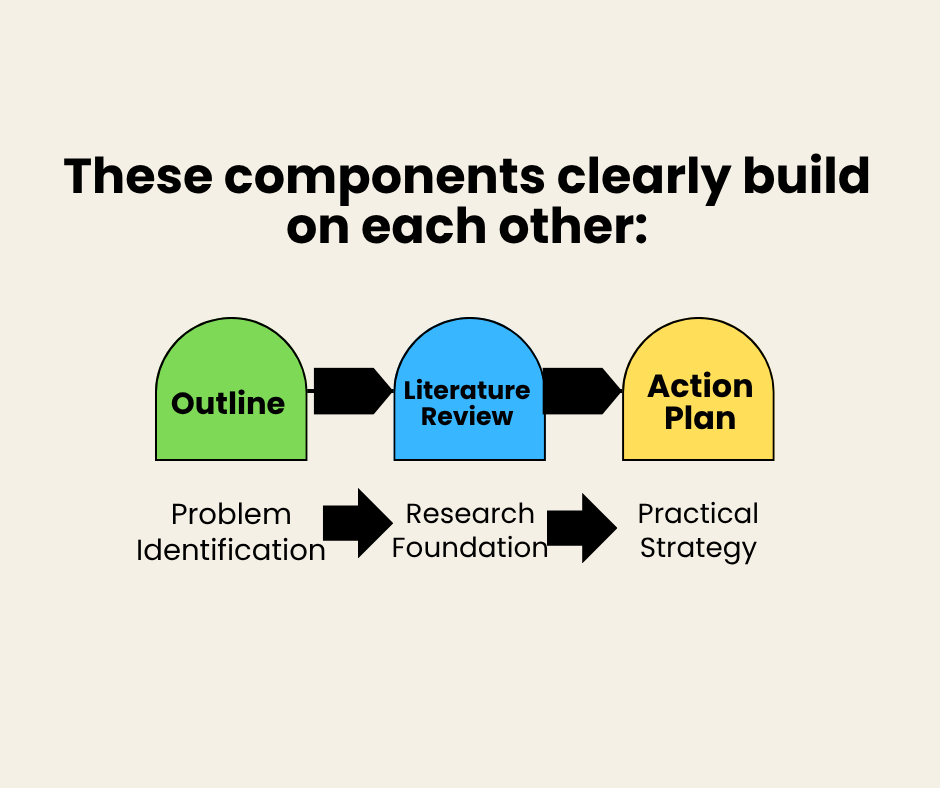
By moving through this progression, I created a plan that is focused, research-driven, and actionable. This ensures that my project not only addresses a real problem but also contributes to long-term improvement for special education students in virtual learning.
References
- Li, Y.-F., Zhang, D., Dulas, H. M., & Whirley, M. L. (2023). The impact of COVID-19 and remote learning on education: Perspectives from university students with disabilities. Journal of Disability Policy Studies, 34(1), 1–9.
- Ruhela, A. (2023). The impact of remote and blended learning on special education. International Journal of Education and Development using Information and Communication Technology, 19(1), 145–160.
- Saxe, R. S. (2020). The effects of using an online reading program to improve learning for special education students(Doctoral dissertation, Liberty University). ProQuest Dissertations Publishing.
- Troxler, C. (2021). Evaluating the impact of the COVID-19 pandemic on students with disabilities. Journal of Special Education Apprenticeship, 10(1), 1–15.
- Ziadat, A. H. (2021). Online learning effects on students with learning disabilities: Parents’ perspectives. International Journal of Educational Research, 110, 101893. https://doi.org/10.1016/j.ijer.2021.101893
 Candace V Johnson
Leave a comment