Call to Action Presentation
(Click the above link)
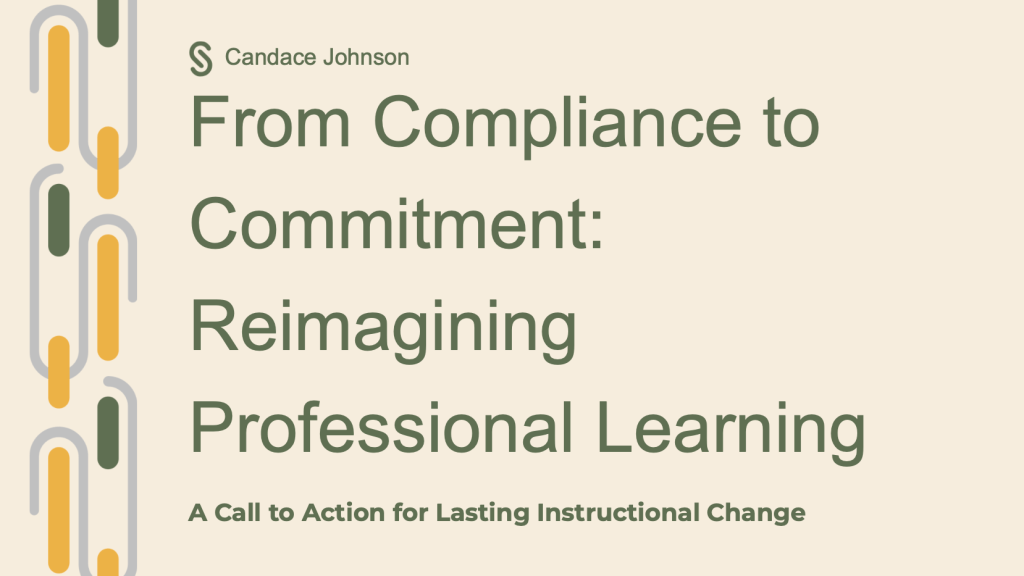
This call-to-action presentation challenges the ineffective status quo of professional learning (PL) and advocates for a shift from passive “sit and get” approaches to meaningful, transformative experiences grounded in the five key principles of effective PL: duration, ongoing support, active engagement, modeling, and relevant content. Drawing on research from Learning Forward, TeachThought, and leading educational thinkers, Candace Johnson makes the case for why now is the time to reimagine how educators grow. Participants will explore the consequences of not implementing change, reflect on the cultural impact of high-quality professional learning, and walk away with a concrete pilot plan to initiate a shift in professional learning practices, starting with leadership.
From Compliance to Commitment: Reimagining Professional Learning
Today I want to speak to something we all care deeply about, professional learning (PL). But not the kind that feels like a checkbox or leaves us wondering how it connects to our classrooms. This is about shifting from compliance-driven learning to something far more impactful, professional learning that leads to lasting instructional change. It’s time for us to reimagine what’s possible (Duarte, 2013).
Let’s be honest. We’ve all sat through professional learning that was well-intended but didn’t stick. Despite districts spending nearly $18,000 per teacher annually on development (TNTP, The Mirage), most teachers report no improvement in their practice. The problem isn’t a lack of effort, it’s a lack of alignment between how we design teacher learning and how adults actually learn. Too often, PL remains passive, disconnected from daily practice, short-lived, and lacking meaningful follow-up. As Gulamhussein (2013) points out, many traditional models simply don’t create the conditions necessary for deep, sustained growth. We’re investing time and money, but we’re not getting the results our educators, or our students deserve.
If we don’t change, we risk more than just wasting time. Ineffective PL contributes to teacher burnout and stagnation. It leaves teachers without tools or support to respond to diverse learner needs. And ultimately, students pay the price. Collaboration, when done right, has been shown to support teacher development and positively impact classroom practice (Goodwin, 2015). But collaboration alone isn’t enough, we need systemic, high-quality learning cycles embedded into school culture.
There is a better way. When we shift from “sit and get” to “go and show,” we create conditions for professional learning that is active, collaborative, and sustained over time. Duarte (2013) reminds us that real change begins with compelling stories and a clear call to action and in this case, the story is that we don’t have to settle for ineffective PL. By rethinking our approach, we can design PL that truly supports instructional change.
To make this shift, we must embrace five foundational principles (Gulamhussein, 2013):
1. “Duration”: Change doesn’t happen overnight. PL must be sustained and embedded in day-to-day practice.
2. “Ongoing Support”: Implementation is hard. Teachers need coaching, collaboration, and check-ins to stay the course.
3. “Active Engagement”: Teachers, like students, learn best when they’re active, discussing, trying, and reflecting.
4. “Modeling”: Teachers must see what new practices look like in action.
5. “Relevant Content”: Content should be specific to teachers’ contexts—grade level, subject, and student population.
Each of these elements builds toward a culture where professional learning is both meaningful and effective.
Let’s pause here because this is where many well-intentioned efforts fall short. Just adding active learning strategies doesn’t ensure better outcomes. In fact, Andrews et al. (2011) found that simply inserting active techniques without attention to alignment, clarity, or cognitive load, did not correlate with student learning gains. The same principle applies to teacher learning. True transformation requires a mindset shift and purposeful design, not surface-level change.
When we get this right, the benefits ripple through our entire school. Teachers feel supported and empowered. They try new strategies and reflect on what’s working. Instruction becomes more cohesive and responsive. And students benefit from more consistent, engaging learning experiences. Goodwin (2015) found that collaborative environments—especially when tied to shared goals—promote teacher growth and lead to improved student outcomes.
But if we don’t change? We risk remaining stuck. PL will continue to feel like a checkbox. Teachers will continue to disengage. And our most vulnerable students will continue to be underserved. As Gulamhussein (2013) emphasized, professional development that lacks meaningful duration and follow-up has little chance of producing real change. We cannot afford to ignore this reality.
Leadership matters. Change begins when school leaders commit to creating a better system of learning. We don’t need to overhaul everything overnight—but we do need to take the first step. Let’s pilot a PL cycle built on collaboration, modeling, and coaching. Let’s listen to teachers and adjust based on real feedback. And let’s build the kind of learning culture we want to see in our classrooms.
The opportunity is in front of us. The time is now. As educators, we expect students to be active, reflective, and supported in their learning—shouldn’t we expect the same for ourselves? Duarte (2013) says the most powerful presentations are those that close the gap between what is and what could be. That’s our job today—to close that gap and move from compliance to commitment. Let’s move forward, together.
Reference
Reynolds, G. (2013). Presentation zen design: Simple design principles and techniques to enhance your presentations. New Riders.
Andrews, T. M., Leonard, M. J., Colgrove, C. A., & Kalinowski, S. T. (2011). Active learning not associated with student learning in a random sample of college biology courses. CBE—Life Sciences Education, 10(4), 394–405. https://doi.org/10.1187/cbe.11-07-0061
Canva. (2025). Custom images and graphics created using Canva design platform [Images]. Canva. https://www.canva.com
Duarte, N. (2013). Resonate: Present visual stories that transform audiences. John Wiley & Sons. http://resonate.duarte.com/#!page0
Goodwin, B. (2015). Research Says/Does Teacher Collaboration Promote Teacher Growth? Educational Leadership, 73(4), 82-83. http://www.ascd.org/publications/educational-leadership/dec15/vol73/num04/Does-Teacher-Collaboration-Promote-Teacher-Growth%C2%A2.aspx
Gulamhussein, A. (2013). Teaching the Teachers: Effective Professional Development in an Era of High Stakes Accountability. Center for Public Education. http://www.centerforpubliceducation.org/system/files/2013-176_ProfessionalDevelopment.pdf
TNTP. (2015). The Mirage: Confronting the Hard Truth About Our Quest for Teacher Development. Retrieved from http://tntp.org/publications/view/evaluation-and-development/the-mirage-confronting-the-truth-about-our-quest-for-teacher-development
Call to Action Video
(Click the above link)
Discover the inspiration and process behind “From Compliance to Commitment: Reimagining Professional Learning.” In this video, educator Candace Johnson shares how frustration with traditional PD models led her to design a more engaging, sustainable approach. Grounded in research and storytelling, her presentation highlights five key principles of effective professional learning: sustained duration, implementation support, active engagement, instructional modeling, and relevance. Learn how thoughtful design, collaboration, and a clear call to action can transform teacher development into meaningful change. Ideal for school leaders and instructional coaches looking to make a lasting impact. Watch now to reimagine what professional learning can be!
The Why
This presentation was born out of both frustration and hope. As an educator, I’ve seen professional learning sessions come and go, many well-meaning, some even inspiring, but few that truly stick. Too often, we default to the “sit and get” model, where teachers passively absorb content they rarely apply. This isn’t just ineffective, it’s disheartening. For educators expected to create engaging, student-centered environments, our learning opportunities must reflect the same philosophy.
The motivation for this presentation came from a deep desire to advocate for something better: a culture where teacher learning is continuous, job-embedded, and purposeful. According to Gulamhussein (2013), one of the most critical characteristics of effective PL is that it must be sustained over time and focused on implementation, two elements frequently absent in traditional models. I was also struck by research highlighting that collaboration among teachers can improve practice and promote retention when paired with purpose and structure (Goodwin, 2015).
What made this relevant to me was seeing the cost of inaction: talented teachers leaving the profession, inconsistent implementation of instructional practices, and missed opportunities to support the very students we claim to serve. Equally influential was the caution from Andrews et al. (2011) that merely adding active learning components without a clear pedagogical shift often fails to produce meaningful results. In other words, change must be systemic and strategic.
The “precedent” for this project came from my exploration of Nancy Duarte’s storytelling model and design principles found in “Presentation Zen” by Garr Reynolds. These frameworks pushed me to move beyond slides packed with bullet points to something that told a story, one that could inspire, challenge, and ignite action (Duarte, 2013; Reynolds, 2013).
The What
The finished product is a visual presentation titled “From Compliance to Commitment: Reimagining Professional Learning.” Designed to persuade school leaders and instructional staff to shift away from passive professional development, the presentation is grounded in the five key principles of effective PL:
1. Sustained duration
2. Ongoing implementation support
3. Active engagement
4. Instructional modeling
5. Content-specific relevance
The presentation follows Duarte’s structure, alternating between the current reality (“what is”) and the vision of possibility (“what could be”), leading to a clear and urgent call to action.
The How
The creation process was as thoughtful as the message itself. I used Canva for design, deliberately keeping visuals clean and focused, adhering to Garr Reynolds’ “Presentation Zen” principles: large visuals, minimal text, and intentional white space to reduce cognitive overload (Reynolds, 2013). I designed custom icons using Canva to visually represent the five key principles that matched the tone and urgency of the message.
To maintain visual coherence, I applied a consistent color palette of deep greens and soft tans to convey harmony and growth. The tone of my speaker script was intentionally direct but hopeful, encouraging leaders to see themselves as co-creators in change rather than obstacles to it.
I used a digital storyboard to organize the flow, referencing Duarte’s (2013) “Resonate” model to ensure the emotional arc moved from tension to resolution. My workspace included open tabs of research articles, citation trackers, and collaborative feedback from colleagues. I used a “backward design” approach, starting with the desired outcome (a mindset shift in leadership) and designing backward to create a sequence of ideas, evidence, and visuals that supported that goal.
All media and references were credited appropriately:
Images: Canva Pro (licensed design assets)
Research: Andrews et al. (2011), Goodwin (2015), Gulamhussein (2013)
Design Frameworks: Duarte’s “Resonate” and Reynolds’ “Presentation Zen”
If the presentation is the movie, then this reflection is the director’s commentary. What I learned through this process is that crafting a persuasive, meaningful presentation isn’t just about content, it’s about connection. Drawing on both my personal experience and peer-reviewed literature made this project not just academic, but deeply personal.
I realized that design and narrative are inseparable from leadership advocacy. Translating research into compelling media helped me find a stronger voice, not only as an instructional leader but as a change agent. This process taught me that the story behind the slides matters just as much as the story on them.
Reference
- Andrews, T. M., Leonard, M. J., Colgrove, C. A., & Kalinowski, S. T. (2011). Active learning not associated with student learning in a random sample of college biology courses. CBE—Life Sciences Education, 10(4), 394–405. https://doi.org/10.1187/cbe.11-07-0061
- Canva. (2025). Custom images and graphics created using Canva design platform [Images]. Canva. https://www.canva.com
- Duarte, N. (2013). Resonate: Present visual stories that transform audiences. John Wiley & Sons. http://resonate.duarte.com/#!page0
- Goodwin, B. (2015). Research Says/Does Teacher Collaboration Promote Teacher Growth? Educational Leadership, 73(4), 82-83. http://www.ascd.org/publications/educational-leadership/dec15/vol73/num04/Does-Teacher-Collaboration-Promote-Teacher-Growth%C2%A2.aspx
- Gulamhussein, A. (2013). Teaching the Teachers: Effective Professional Development in an Era of High Stakes Accountability. Center for Public Education. http://www.centerforpubliceducation.org/system/files/2013-176_ProfessionalDevelopment.pdf
- Reynolds, G. (2013). Presentation zen design: Simple design principles and techniques to enhance your presentations. New Riders.
- TNTP. (2015). The Mirage: Confronting the Hard Truth About Our Quest for Teacher Development. Retrieved from http://tntp.org/publications/view/evaluation-and-development/the-mirage-confronting-the-truth-about-our-quest-for-teacher-development
 Candace V Johnson
Leave a comment